

- All animals are purchased through the SAP system and must adhere to the Animal Procurement Order (ANPO) guidelines.
- All animal research must be approved by the Animal Care and Use Committee (ACUC).
- No animal may enter any Johns Hopkins animal facility except through Research Animal Resources.
- JHU shopping carts are required to be approved by 5:00 PM every Tuesday, by first-level department approvers, to arrive the following week, depending on availability.
Need Help?
Contact the RAR Business Office at 410-955-3713 or [email protected] for assistance or additional information.
Research Animal Sources
Most research animals used within JHU are purchased from commercial suppliers and dealers.
Animals entering JHU from private sources or other institutions require approval from the rodent import coordinator.
Rodents
Rodents purchased from JHU-approved vendors may be brought directly into JHU rodent colonies, which are maintained free from a wide variety of rodent pathogens. Rodents acquired from non-approved vendors or other institutions must be brought in through rodent quarantine, where they are assessed for excluded pathogens.
Approved Rodent Sources |
|
|---|---|
| Supplier | Species |
| Charles River Laboratories | mice, rats Instructions for placing CRL orders |
| Envigo | mice, rats |
| Hilltop | mice, rats, guinea pigs |
| Jackson Laboratories | mice Instructions for placing Jackson Labs orders |
| NIA | mice, rats Instructions for placing NIA orders |
| Taconic | mice, rats |
| MMRRC Missouri | mice |
| MMRRC UNC Chapel Hill | mice |
Non-Human Primates
Johns Hopkins manages breeding colonies of SPF rhesus macaques (Macaca mulatta) and SPF pigtail macaques (Macaca nemestrina). Both male and female animals are available for either sale or for lease, depending on the study requirements. For questions regarding animal availability and primate sales, please email [email protected].
Other primate species (e.g., common marmosets, cynomolgus macaques, baboons, squirrel monkeys, owl monkeys, African green monkeys) are available from NPRCs and commercial importers and breeders. All primates from outside sources must undergo a quarantine period upon arrival at Johns Hopkins facilities, usually lasting a minimum of 6 weeks. For questions regarding primate acquisition, please email [email protected].
Large Animals
Larger animals, such as dogs, cats, rabbits, and farm animals, are available commercially from a limited number of sources. Special request orders, such as pregnant sheep or goats, must be placed well in advance and may have seasonal availability.
Approved Large Animal Sources |
|
|---|---|
| Supplier | Species |
| Archer Farms | pigs, sheep |
| Bonita Sensenig | pigs, sheep |
| Charles River Labs | rabbits |
| Inotiv | rabbits |
| Marshall Bioresources | dogs, cats |
| Sinclair Bio Resources | pigs, sheep |
| Tom Morris | pigs, sheep |
Instructions for Placing Large Animal Orders
- Email the Large Animal Team at [email protected] to obtain study and animal housing approval.
- The JHU housing area needs to be confirmed with the RAR housing supervisor and should be clearly indicated in the shopping cart (building, room #, and suite # if applicable)
- Obtain a quote from an approved large animal supplier.
- Follow each vendor’s specific instructions for obtaining quotes to ensure accurate pricing when placing animal orders.
- Create an animal shopping cart using ANPO.
- All animal shopping carts must adhere to the ANPO Guidelines.
Non-Traditional Species
For questions regarding non-traditional species, please email [email protected].
Non-traditional species include, but are not limited to, any avian, herpetological, aquatic, invertebrate, or other species that are not commonly housed in a research setting. Species that are acquired from approved vendors may be added to colonies directly. If sourcing from another vendor, a quarantine period may be required prior to their introduction. This is on a case-by-case basis and will be coordinated through the [email protected].
Approved Non-Traditional Species Sources |
|
|---|---|
| Vendor | Species |
| Maryland Exotic Birds | zebra finches |
| National Xenopus Resource | xenopus sp. |
| Carolina Biological Supply | rana sp. |
Placing Animal Orders

New Investigators
Before you order:
1. Ensure that your study has an approved ACUC protocol.
2. Submit a request to establish an eSirius ID.
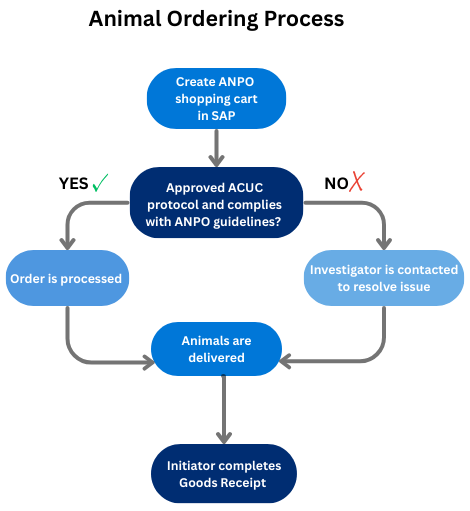
- All animal orders must be placed through SAP using an Animal Procurement Order (ANPO) shopping cart.
- Follow the ANPO Guidelines for placing animal orders.
- Instructions for CRL orders
- Instructions for NIA orders
- Instructions for Jackson Labs orders
- Follow each vendor’s specific instructions for obtaining quotes to ensure accurate pricing when placing animal orders.
- Provide:
- Valid ACUC protocol number
- Vendor quote
- Accurate item description, stock #, and price
- Complete housing area location
Animal Ordering Holiday Deadlines (TBD)
- The JHU winter holiday is December 24, 2026 – January 1, 2027. The deadline for ordering animals is TBD.
- Investigators should plan for and anticipate possible delays in ordering and delivery during this time due to both JHU and vendor closures. Specific questions can be emailed to [email protected].
Animal Ordering Service Rates
SERVICE ITEM | UNIT | FY27 RATE |
|---|---|---|
| Rodent Ordering Fee | Each | $11.00 |
| Other Ordering Fee | Each | $57.00 |
| Non-Mammal Ordering Fee | Each | $11.00 |
All rar FY26 Technical service rates
Common Issues That Cause Delay
If your order has any of the following issues, it will be rescheduled for two weeks later:
- Animal not available
- No housing space available
- Expired or invalid protocol number
- The order quantity exceeds the approved animal count
- Missing or incorrect info (protocol number, housing area, PI name, stock number, price, age, weight, sex)
What Happens After Ordering
After Delivery
It is the responsibility of all ANPO order initiators to complete all Goods Receipts within 7 days of delivery to comply with JHU policy and to initiate payment for goods received
- The animal ordering team validates protocols and verifies compliance with ANPO Guidelines before processing.
- You will be notified by email of any issues or delays.
- Once approved, animals are shipped and delivered to JHU’s central receiving dock.
- Upon arrival, RAR staff inspect animals and deliver them to housing facilities. View all RAR Housing and Per Diem rates.
* Animals without a valid JHU Purchase Order (PO) number will not be delivered.